
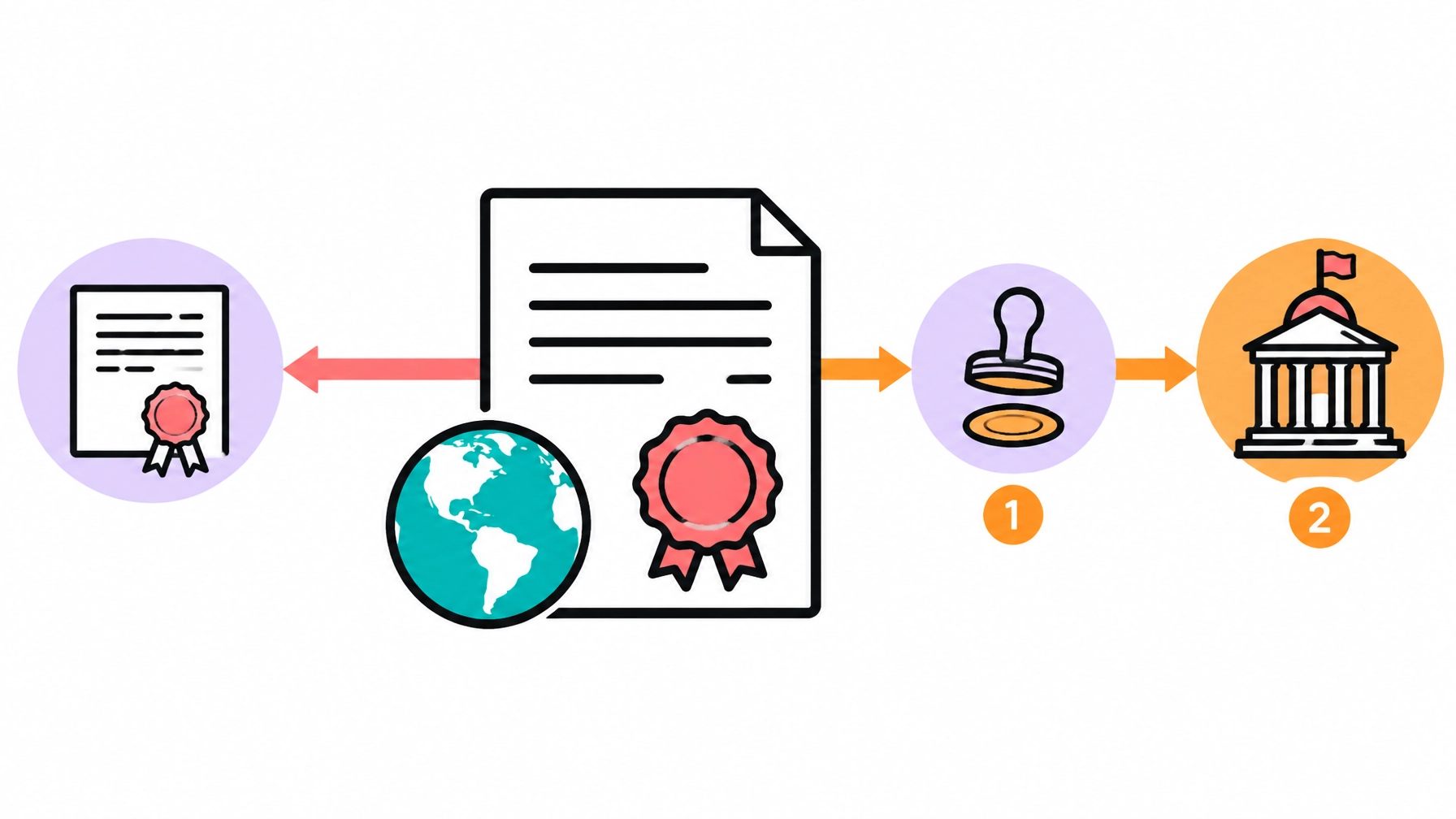
If you need to use a U.S. document in another country, you may need an apostille or embassy legalization. These services are not interchangeable.
The correct process depends mainly on:
- The country where your document will be used
- Whether that country is part of the Hague Apostille Convention
- Whether your document was issued by a state authority or the federal government
- The document type and certification requirements
Use the steps below to identify the correct path before submitting your document.
The main difference
An apostille is a certificate used to authenticate a public document for use in another country that is part of the 1961 Hague Apostille Convention.
Embassy legalization is a multi-step authentication process used when the destination country is not part of the Hague Apostille Convention. It usually includes government authentication followed by certification from the destination country’s embassy or consulate.
The destination country determines which process applies. Do not select a service based only on the document type.

When your document needs an apostille
You generally need a document apostille when both conditions apply:
- The document was issued in the United States.
- The document will be used in a country that is a member of the Hague Apostille Convention.
An apostille confirms the authenticity of the signature, seal, or stamp on a public document. It does not confirm that the information inside the document is accurate, and it does not replace a required translation.
Common documents that may require an apostille include:
- Birth certificates
- Marriage certificates
- Death certificates
- Divorce decrees
- Court orders
- Powers of attorney
- Affidavits
- Corporate documents
- Certificates of good standing
- Diplomas and school records
- FBI background checks
- Documents notarized by a public notary
The correct issuing authority depends on where the document originated.
State-issued documents
Documents issued by a state, county, or local authority usually require processing through the Secretary of State or another designated state authority.
For example, a document issued in New York may need to be handled through the New York Department of State apostille and authentication process.
A notarized document may also require an additional county clerk or state certification before an apostille can be issued. Requirements vary based on the notary’s commission and the type of document.
Federal documents
Documents issued by a U.S. federal agency generally require an apostille from the U.S. Department of State Office of Authentications.
Examples may include:
- FBI background checks
- Federal court documents
- Documents signed by federal officials
- Certain federal agency records
State authorities cannot issue an apostille for a federal document. The document must be submitted to the appropriate federal authority.
When your document needs embassy legalization
If the destination country is not a member of the Hague Apostille Convention, an apostille is generally not the correct certificate.
The document may instead require authentication and embassy legalization. This process often includes:
- Certification by the issuing state authority, when required
- Authentication by the U.S. Department of State or another federal authority
- Legalization by the destination country’s embassy or consulate
The exact steps depend on the destination country. Some embassies require additional forms, translations, processing fees, or document certifications.
Do not assume that an apostille can be used for every international document. An apostille issued for the wrong destination country may not be accepted.
Before ordering, confirm the requirements with:
- The receiving government office
- The destination country’s embassy or consulate
- The school, employer, court, bank, or business requesting the document
- The relevant U.S. issuing authority
The U.S. Department of State and USA.gov provide general guidance for authenticating U.S. documents for international use.
How to determine the correct service
Use this process before sending your original document.
1. Identify the destination country
The country where the document will be used determines whether you need an apostille or embassy legalization.
The country where you currently live does not determine the process. A document may need authentication for the country where it will be submitted, even if you are located somewhere else.
2. Check the Hague Convention status
Review the current member list maintained by the Hague Conference on Private International Law.
If the destination country is listed as a Hague Convention member, an apostille may be appropriate.
If the country is not listed, you may need authentication and embassy legalization instead.
Membership status, objections, and document requirements can change. Verify the current requirements before submitting your document.
3. Confirm where the document was issued
Determine whether your document is:
- State-issued
- County-issued
- Federally issued
- Notarized
- Issued by a school or private organization
The issuing authority determines where the document must be certified and which office can issue the final apostille or authentication certificate.
4. Confirm the document format
Many authorities require an original document or a certified copy. A plain photocopy may not be accepted.
You may also need:
- A current certified vital record
- A court-certified copy
- A notarized signature
- A county clerk certification
- A certified translation
- A specific document date
- A completed application form
Check these requirements before mailing documents or booking service.

Apostille services for common documents
Our apostille services are designed to help with documents that must be recognized internationally. We can help review the basic document and destination requirements, identify the likely certification path, and coordinate eligible apostille processing.
Common requests include:
- Personal documents for marriage or immigration
- Powers of attorney for use abroad
- Business formation and corporate records
- School and employment documents
- Court documents
- Background checks
- Documents prepared for international business transactions
Requirements vary by document and destination country. A document apostille does not automatically include translation, document correction, replacement of a vital record, or legal advice.
If your document is incomplete, incorrectly certified, or issued by the wrong authority, it may be rejected. Review the document before submitting it for an international apostille service.
Apostille versus embassy legalization: quick decision guide
Use this basic guide:
Select apostille when:
- The destination country is a Hague Convention member
- The document is eligible for apostille certification
- The document has the required original or certified format
- The receiving organization requests an apostille
Select embassy legalization when:
- The destination country is not a Hague Convention member
- The receiving authority specifically requests consular legalization
- The embassy or consulate provides a multi-step authentication procedure
- The document requires federal authentication before embassy review
If the receiving organization uses the term “authentication,” ask what certificate it means. In some situations, “authentication” refers to a government certificate. In others, it may be used as a general term for the entire international document process.
What we need to review your request
Provide the following details before selecting a service:
- Destination country
- Document type
- State or federal issuing authority
- Whether the document is original or certified
- Whether the document has already been notarized
- Intended use of the document
- Required completion date
- Whether a translation is required
This information helps identify the correct certified document authentication path.
Do not send an original document until the receiving authority confirms that it is acceptable and the processing requirements are clear.
Start your document authentication request
We provide remote notary and apostille support for clients in the United States and internationally.
Use our booking page to provide service details and select the next available option. For remote notarization needs, review our remote notary service information. You can also review available service details through our pricing page.
Before submitting your request:
- Confirm the destination country.
- Check whether it is a Hague Convention member.
- Identify the document’s issuing authority.
- Confirm whether the receiving office requires an apostille or embassy legalization.
- Provide the document details and required timeline.
Apostilles and embassy legalization follow different procedures. Select the process required by the destination country and document authority before proceeding.
This article provides general administrative information and is not legal advice. Requirements may change and may differ by country, document type, issuing authority, and receiving organization. Confirm current requirements with the destination authority before submitting documents.

Leave a Reply